Rotatory transmission mechanisms.

Rotary motion is one of the most common ones because it is the one that motors produce.

Rotary transmission mechanisms transfer these motions from the driver shaft to the driven shaft.

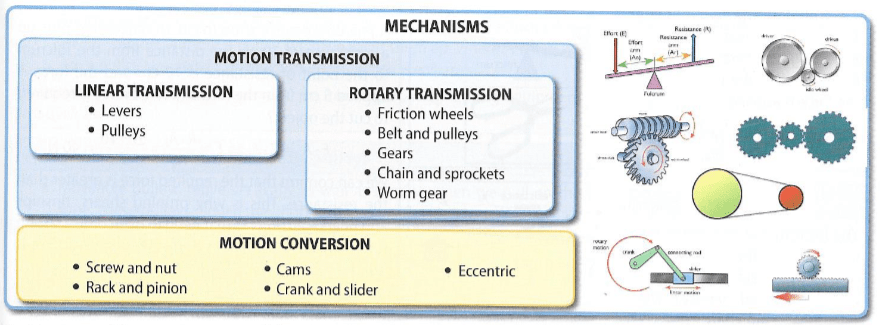
Friction wheels:

They are a set of two whels located one next to the other. Motion is transmitted between the wheels by the friction between them.

The transmission ratio is the ratio between the size of the frictin wheels and the speed of rotation.

i = w1/w2 = d2/d1
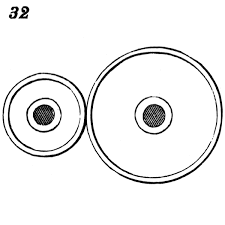
BELT AND PULLEY SYSTEM:

This system is made up of two pulley wheels joined by a belt that slots into the grooved rim of the wheels.
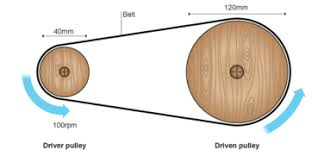
GEARS:

A gear is a mechanism consisting of two wheels with teeth.
Linear transmission mechanisms.

Linear transmission mechanisms area type of simple machine. Examples of linear transmission mechanisms era levers and pulleys.

LEVERS:

A lever is a rigid bar that can pivot on a point of support called a fulcrum. It is used to lift load by applying force to a point on the bar. We call the applied force effort, and the load to be lifted the resistance.

Resultado de imagen de lever

The law of the lever states that:

E · Ae = R · Ar

There are 3 different classes:

Class 1:

The fulcrum is located between the effort and the resistance.

Class 2:

The resistance is located between the effort and the fulcrum.

Class 3:

The effort is  located between the resistance and fulcrum.

PULLEYS:

Pulleys are used to lift heavy loads. They are wheels with a grooved rim.

Resultado de imagen de pulley

There are 2 types of pulleys:

Fixed:

The axis of rotation of the pulley is fixed by attaching it to a support that prevents if from moving.

With fixed pulleys, we still have to put in the same effort to lift the weight, but they make the task easier.

Moveable:

Move vertically as well as turning when we pull on the rope. These pulleys reduce the effort required to a half.

Systems made up of moveable and fixed pulleys are called hoists. The force needed to lift a load in a hoist is reduced in proportion to the number of moveable pulleys in the system.